Generative AI in Construction Management
The construction industry has traditionally been considered one of the slowest sectors to adopt digital transformation. Delays, cost overruns, labor shortages, safety risks, and communication gaps have affected projects for decades. However, the rise of Generative Artificial Intelligence (Generative AI) is rapidly changing the landscape of construction management.
From automated project planning and predictive scheduling to intelligent design optimization and real-time risk analysis, Generative AI is becoming a game-changing technology for the Architecture, Engineering, and Construction (AEC) industry. Companies worldwide are now investing heavily in AI-powered construction tools to improve productivity, reduce waste, and make smarter decisions. (MDPI)
As the global construction market moves toward digital transformation, Generative AI is no longer a futuristic concept. It is actively reshaping how projects are designed, managed, monitored, and delivered.
What is Generative AI in Construction Management?
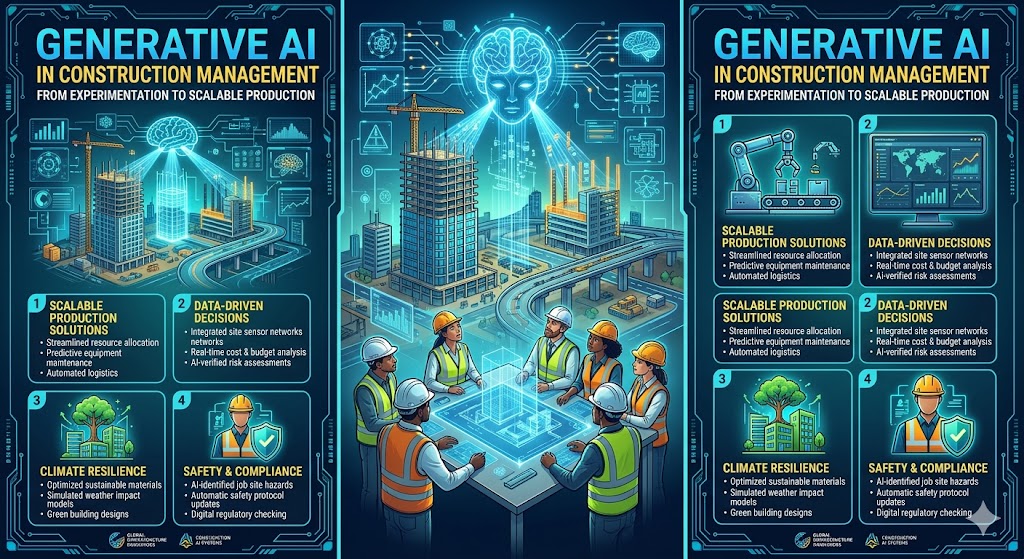
Generative AI refers to advanced artificial intelligence systems capable of creating new content, designs, schedules, reports, simulations, and predictive insights based on existing data and user prompts.
In construction management, Generative AI can:
- Generate project schedules
- Create BIM-based design alternatives
- Predict project risks
- Automate documentation
- Optimize resource allocation
- Improve safety planning
- Generate cost estimates
- Assist in procurement management
Unlike traditional software that follows predefined instructions, Generative AI learns patterns from massive datasets and produces intelligent recommendations in real time.
According to a recent systematic review published in Buildings Journal, Generative AI is increasingly being applied across construction workflows, including safety management, BIM integration, project planning, and GPT-based automation systems. (MDPI)
Why the Construction Industry Needs Generative AI
The construction industry faces several long-standing challenges:
- Low productivity
- Frequent delays
- Budget overruns
- Skilled labor shortages
- Communication inefficiencies
- Safety hazards
- Poor data management
Research from McKinsey & Company shows that construction productivity growth remained extremely low compared to manufacturing and other industries over the last two decades. (McKinsey & Company)
Generative AI addresses these issues by improving:
- Automation
- Decision-making
- Predictive analysis
- Collaboration
- Workflow optimization
This technology allows project managers to focus more on strategy and execution rather than repetitive administrative work.
How Generative AI is Transforming Construction Management
1. AI-Powered Project Planning and Scheduling
One of the biggest advantages of Generative AI is intelligent project planning.
Traditional scheduling methods often depend heavily on manual inputs and historical assumptions. Generative AI can analyze:
- Previous project data
- Weather patterns
- Labor availability
- Supply chain trends
- Site conditions
It then creates optimized schedules with reduced delays and improved resource utilization.
AI systems can also dynamically update schedules when disruptions occur, helping project managers make faster decisions.
Modern AI platforms now predict:
- Delay probabilities
- Critical path risks
- Equipment bottlenecks
- Material shortages
This predictive capability significantly improves project control.
2. Building Information Modeling (BIM) Integration
Building Information Modeling (BIM) has already transformed construction planning, but Generative AI is taking BIM to the next level.
AI-powered BIM systems can:
- Generate multiple design alternatives
- Detect clashes automatically
- Optimize building layouts
- Improve sustainability performance
- Reduce material wastage
Autodesk AI is among the leading platforms integrating Generative AI into design and construction workflows. Autodesk reports that AI can accelerate design iterations, improve risk prevention, and provide predictive insights for project teams. (Autodesk)
Generative AI also helps architects and engineers create smarter structures faster by automatically producing design recommendations based on project goals.
3. Smarter Cost Estimation and Budget Management
Cost overruns remain one of the biggest problems in construction management.
Generative AI can improve cost estimation by analyzing:
- Historical project costs
- Material price fluctuations
- Labor trends
- Market conditions
- Productivity rates
AI-powered estimation tools provide:
- More accurate BOQs
- Real-time budget forecasting
- Procurement optimization
- Cash flow predictions
This allows contractors and project owners to reduce financial risks significantly.
AI can even generate alternative procurement strategies to minimize costs while maintaining project quality.
4. Construction Safety Enhancement
Construction sites are inherently dangerous environments.
Generative AI is now being used for:
- Hazard prediction
- Safety monitoring
- Worker behavior analysis
- Risk detection
- Incident prevention
AI systems analyze site images, CCTV footage, and drone data to identify unsafe conditions before accidents occur.
According to industry studies, AI-based safety systems are becoming one of the fastest-growing applications in construction technology. (ScienceDirect)
Some companies now use AI-driven wearables and cameras that detect:
- Missing PPE
- Unsafe worker movement
- Equipment proximity risks
- Fall hazards
This proactive approach can drastically improve worker safety.
5. Automated Documentation and Reporting
Construction management involves massive amounts of paperwork:
- Daily progress reports
- RFIs
- Site inspection reports
- Meeting minutes
- Procurement logs
- Client updates
Generative AI tools can automatically generate these documents in seconds.
Large Language Models (LLMs) like GPT-based systems are increasingly being integrated into project management platforms to automate communication and reporting tasks. (ScienceDirect)
This reduces:
- Administrative workload
- Human errors
- Reporting delays
Project managers can save significant time and focus more on execution and coordination.
6. AI-Driven Design Optimization
Generative design is one of the most revolutionary aspects of AI in construction.
Instead of manually creating a single design, Generative AI produces multiple optimized design options based on:
- Structural requirements
- Budget limits
- Sustainability goals
- Space utilization
- Material efficiency
Autodesk Construction Cloud highlights how AI improves decision-making, quality outcomes, and project efficiency through intelligent automation. (Autodesk Construction Cloud)
AI-generated designs help reduce:
- Rework
- Material waste
- Construction time
- Energy consumption
This is especially important for sustainable construction and green building projects.
7. Digital Twins and Real-Time Project Monitoring
Digital twin technology combined with Generative AI enables real-time monitoring of construction projects.
A digital twin is a virtual replica of a physical building or construction site.
AI-powered digital twins can:
- Simulate project progress
- Predict maintenance needs
- Monitor equipment performance
- Identify operational risks
- Improve lifecycle management
Recent AI developments involving simulation tools and digital twins are already being applied in large infrastructure and energy projects. (Tom’s Hardware)
This technology gives project managers unprecedented visibility into project performance.
The Role of Generative AI in Sustainable Construction
Sustainability has become a major priority in modern construction.
Generative AI supports sustainable construction by:
- Optimizing material usage
- Reducing carbon emissions
- Improving energy efficiency
- Minimizing waste generation
- Enhancing lifecycle analysis
AI systems can recommend:
- Low-carbon materials
- Energy-efficient building layouts
- Sustainable structural alternatives
This helps organizations meet ESG goals and environmental compliance requirements.
Challenges of Generative AI in Construction Management
Despite its massive potential, Generative AI adoption still faces several challenges.
1. Data Quality Issues
AI systems require high-quality project data.
Many construction companies still struggle with:
- Poor documentation
- Fragmented systems
- Inconsistent reporting
- Limited digital infrastructure
Without accurate data, AI outputs may become unreliable.
2. Resistance to Change
Construction is traditionally conservative regarding technology adoption.
Many professionals remain skeptical about:
- AI-generated decisions
- Automation replacing jobs
- Dependence on software systems
However, experts increasingly emphasize that AI is more likely to assist professionals rather than fully replace them. (arXiv)
3. AI Hallucinations and Accuracy Risks
Generative AI models can sometimes generate incorrect or misleading outputs, commonly known as hallucinations.
In construction, inaccurate recommendations could lead to:
- Design errors
- Safety risks
- Cost miscalculations
- Compliance issues
This is why human oversight remains essential.
4. Cybersecurity and Data Privacy
Construction projects contain highly sensitive data, including:
- Structural drawings
- Financial details
- Client information
- Infrastructure data
AI systems must maintain strong cybersecurity protections to avoid breaches.
Future Trends of Generative AI in Construction
The future of construction management will be deeply connected with AI technologies.
Emerging trends include:
- AI-powered autonomous equipment
- Robotics integration
- Voice-based project management
- AI-generated smart contracts
- Predictive maintenance systems
- Fully automated project reporting
Research papers now describe concepts like “Lean 5.0,” where human expertise and AI collaboration work together to improve construction efficiency and forecasting accuracy. (arXiv)
Industry leaders are also investing heavily in spatial intelligence and AI-generated 3D environments for future construction workflows. (Reddit)
Will Generative AI Replace Construction Managers?
The simple answer is no.
Generative AI will transform the role of construction managers, not eliminate them.
Human expertise is still critical for:
- Leadership
- Negotiation
- Site decision-making
- Stakeholder management
- Ethical judgment
- Conflict resolution
AI works best as a powerful assistant that enhances productivity and decision-making.
Construction professionals who learn AI tools will likely become more valuable in the future.
Conclusion
Generative AI is rapidly becoming one of the most transformative technologies in construction management. From project scheduling and BIM optimization to safety monitoring and predictive analytics, AI is solving many long-standing industry challenges.
Companies adopting AI-driven construction management systems are already experiencing:
- Faster project delivery
- Better cost control
- Improved safety
- Enhanced productivity
- Smarter decision-making
While challenges such as data quality, cybersecurity, and adoption resistance still exist, the future clearly points toward AI-powered construction ecosystems.
As digital transformation accelerates across the AEC industry, Generative AI will likely become an essential tool rather than an optional innovation.
The construction companies that embrace AI today will be the industry leaders of tomorrow.
 20
20
 620
620
 20
20
Hi, I’m Vivek Mishra, Founder of TheTechFace. I am a Civil Engineer and digital content creator with a B.Tech from SRM University (2013) and an MBA (2023). My passion for technology and blogging began during my college years, leading me to create several websites and online platforms.
With over a decade of experience in both engineering and blogging, I write about Technology, AI, Gadgets, Cricket, Civil Engineering, Business, SEO, and digital trends. Through TheTechFace, my goal is to share practical, informative, and easy-to-understand content that helps readers stay informed and make better decisions in a rapidly evolving digital world.