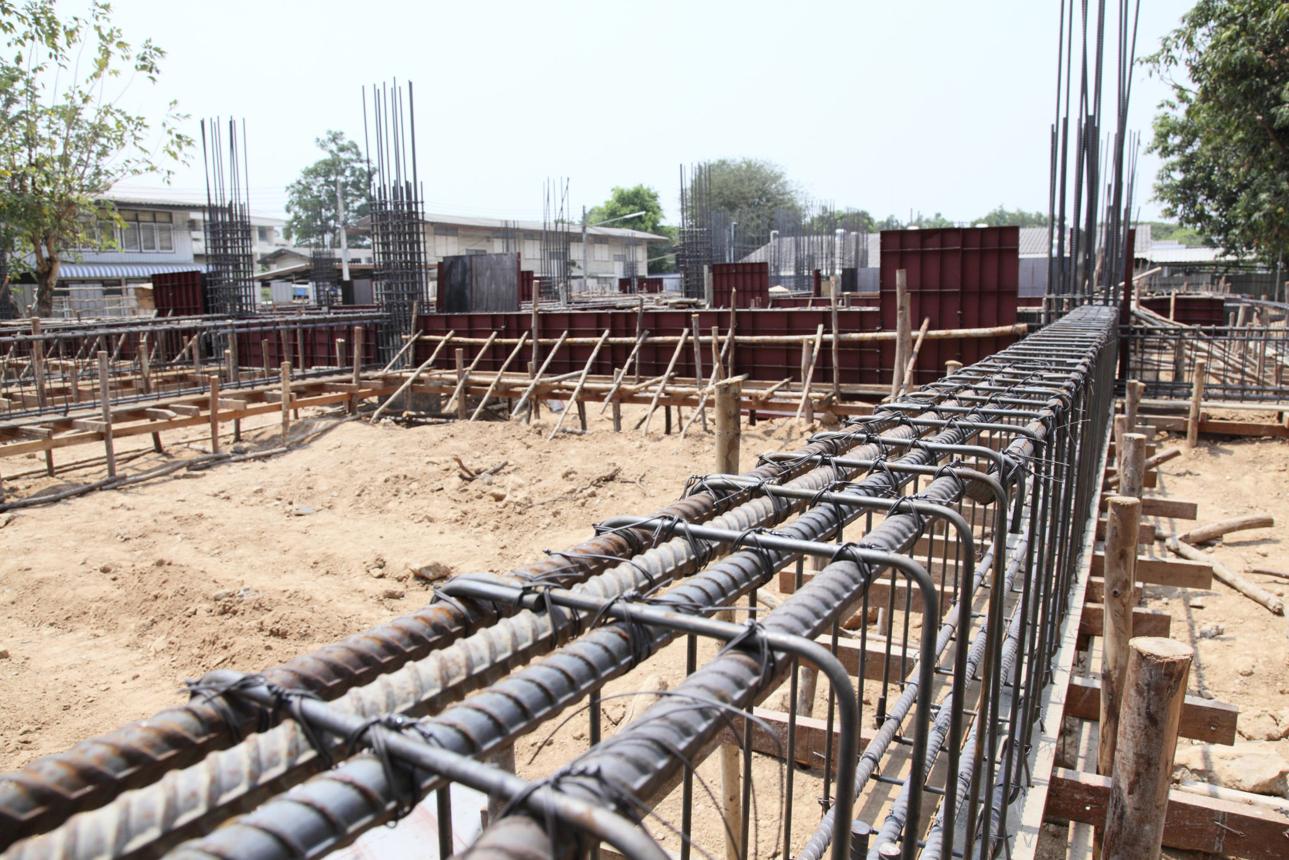
Main Bar and Cross Bar in BBS (Easy Method)


One of the most common questions among civil engineering students and site engineers is:
“How do I know which reinforcement is the Main Bar and which is the Cross Bar in a BBS?”
The answer depends on the structural drawing, slab span, reinforcement direction, and steel quantity. Below are the easiest methods used by experienced site engineers.
Practical BBS Calculation Examples for Beam, Column, and Footing
Method 1: Check the Span Direction (Most Important)
The simplest way to identify the main bar is by checking the length and width of the slab.
Example
Slab Size = 5 m × 3 m
- Longer Span = 5 m
- Shorter Span = 3 m
Since the slab bends more across the shorter span, the Main Bars are provided in the shorter span direction.
The Cross (Distribution) Bars are placed perpendicular to the main bars.
Rule to Remember
| Slab Type | Main Bar Direction | Cross Bar Direction |
|---|---|---|
| One-Way Slab | Shorter Span | Longer Span |
Memory Tip:
Main Bars always work across the shorter span because that is where maximum bending occurs.
Method 2: Check the Bar Diameter
Another easy way to identify reinforcement in the BBS is by looking at the diameter of the steel bars.
Example:
| Bar Mark | Diameter |
|---|---|
| B1 | 12 mm |
| B2 | 8 mm |
Here,
- 12 mm = Main Bar
- 8 mm = Cross Bar
Generally,
- Main Bars = 10 mm, 12 mm, 16 mm
- Cross Bars = 8 mm or 10 mm
Note: Always verify with the structural drawing, as some designs may use the same diameter for both directions.
Method 3: Check the Spacing
Spacing is another reliable indicator.
Example:
- 12 mm @ 150 mm c/c
- 8 mm @ 200 mm c/c
The reinforcement with closer spacing is generally the Main Bar.
Why?
Main bars carry more load, so more steel is required.
Method 4: Check the Cutting Length in BBS
Look at the cutting length of each bar.
Example:
| Bar | Cutting Length |
|---|---|
| B1 | 4950 mm |
| B2 | 2950 mm |
For a 5 m × 3 m slab:
- Bars with a cutting length close to 5 m are laid along the short direction and are the Main Bars.
- Bars with a cutting length close to 3 m are laid along the long direction and are the Cross Bars.
This often confuses beginners because the bar itself is longer, but it is placed in the direction that spans the shorter distance between supports.
Method 5: Read the Structural Drawing


Every structural drawing includes bar marks such as:
- B1
- B2
- T1
- T2
The drawing or reinforcement schedule usually specifies:
- Bar Diameter
- Spacing
- Top or Bottom reinforcement
- Main reinforcement
- Distribution reinforcement
Always cross-check the BBS with the reinforcement drawing before fabrication.
Method 6: Identify from the BBS Table
A typical BBS looks like this:
| Bar Mark | Diameter | Spacing | Length | Type |
|---|---|---|---|---|
| B1 | 12 mm | 150 mm c/c | 5.0 m | Main Bar |
| B2 | 8 mm | 200 mm c/c | 3.0 m | Cross Bar |
The bar with:
- Larger diameter
- Smaller spacing
- Higher steel quantity
is generally the Main Bar.
How to Identify Main and Cross Bars in a Two-Way Slab
In a two-way slab, both directions resist bending.
Therefore:
- Both directions contain Main Reinforcement.
- One direction may still have slightly larger bars or closer spacing if the bending moment is higher.
- Do not assume that one direction is only a distribution bar; always follow the structural design.
Site Engineer’s Quick Identification Formula
Use this checklist on site:
✅ Check the shorter span.
✅ Check the larger diameter.
✅ Check the closer spacing.
✅ Check the higher steel quantity.
✅ Verify the structural drawing.
✅ Match the BBS bar marks.
If all these indicators point to the same reinforcement, you’ve correctly identified the Main Bar.
Common Mistakes While Identifying Main Bars
Many beginners make these mistakes:
- Assuming the longest bar is always the main bar.
- Ignoring the slab span direction.
- Looking only at the bar diameter.
- Not checking reinforcement spacing.
- Preparing BBS without referring to structural drawings.
- Confusing one-way and two-way slab reinforcement.
Conclusion
Understanding how to identify Main Bars and Cross Bars in a Bar Bending Schedule (BBS) is a fundamental skill for every civil engineer, site supervisor, quantity surveyor, and construction professional. While the BBS provides detailed information about reinforcement bars, correctly distinguishing between main and cross bars requires careful analysis of the structural drawing, slab span, bar diameter, spacing, cutting length, and steel quantity. Relying on a single parameter can lead to errors, so it is always recommended to evaluate all these factors together before fabrication or reinforcement placement.
In a one-way slab, the identification process is relatively straightforward—the main bars are placed along the shorter span to resist the maximum bending moment, while the cross (distribution) bars are placed perpendicular to them along the longer span. In two-way slabs, however, both directions carry structural loads, making it essential to follow the structural engineer’s design rather than assuming one direction contains only distribution reinforcement.
For site engineers, the safest approach is to always begin with the structural reinforcement drawing, then verify the bar diameter, spacing, cutting length, and bar marks mentioned in the BBS. This practice not only ensures the correct placement of reinforcement but also helps prevent costly construction mistakes, minimizes steel wastage, and improves the overall quality and durability of reinforced concrete structures.
Whether you are preparing a Bar Bending Schedule, estimating reinforcement quantities, or supervising RCC work on-site, mastering the identification of main bars and cross bars will enhance your technical knowledge and improve your confidence in handling reinforcement detailing. By following the methods explained in this guide, you can accurately interpret any BBS and ensure that reinforcement is executed exactly as intended in the structural design.
 20
20
 620
620
 20
20
Hi, I’m Vivek Mishra, Founder of TheTechFace. I am a Civil Engineer and digital content creator with a B.Tech from SRM University (2013) and an MBA (2023). My passion for technology and blogging began during my college years, leading me to create several websites and online platforms.
With over a decade of experience in both engineering and blogging, I write about Technology, AI, Gadgets, Cricket, Civil Engineering, Business, SEO, and digital trends. Through TheTechFace, my goal is to share practical, informative, and easy-to-understand content that helps readers stay informed and make better decisions in a rapidly evolving digital world.