
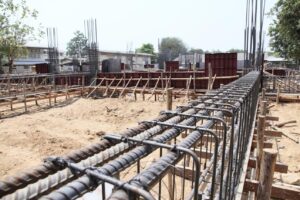

Steel Weight Calculation: TMT Bar Weight Formula
Steel weight calculation is one of the most useful calculations for civil engineers, site engineers, quantity surveyors, contractors, bar benders and construction professionals. Whether you are preparing a Bar Bending Schedule (BBS), checking steel consumption, estimating reinforcement quantities or verifying a supplier’s bill, knowing the weight of TMT bars is essential.
The good news is that you do not need a complicated formula or software for most site calculations.
A simple formula based on the bar diameter and length can calculate the approximate theoretical weight of a TMT steel bar quickly.
In this guide, we will explain the TMT bar weight formula, provide a steel weight chart, show practical examples and give you a free steel weight calculator that you can use directly on your mobile or computer.
Bar Bending Schedule Calculation Step by Step: Complete Guide for Civil Engineers
What Is the TMT Bar Weight Formula?
The commonly used formula for calculating the theoretical weight of a round steel bar is:
Weight = D² × L / 162
Where:
- D = Diameter of steel bar in mm
- L = Length of steel bar in metres
- Weight = Weight of steel bar in kg
For a more precise theoretical calculation using steel density of approximately 7,850 kg/m³, the constant is about 162.2:
Weight = D² × L / 162.2
The commonly used D²/162 formula is a convenient site calculation shortcut. The derivation using the circular cross-sectional area and steel density gives approximately 0.006165 × D² kg/m, which is equivalent to dividing by about 162.2. (TryBuildCalc)
For everyday construction estimation, D²/162 is widely used because it is simple and produces very close results.
How to Calculate Steel Weight Step by Step
Suppose you have a 12 mm diameter TMT bar with a total length of 12 metres.
Using the formula:
Weight = D² × L / 162
Therefore:
Weight = 12 × 12 × 12 / 162
Weight = 10.67 kg approximately
Using the more precise 162.2 constant:
Weight = 12 × 12 × 12 / 162.2
Weight ≈ 10.65 kg
So, a 12 mm TMT bar of 12 metres weighs approximately 10.65–10.67 kg theoretically.
TMT Bar Weight Chart
The following table gives commonly used TMT bar sizes and their approximate theoretical weight per metre.
| TMT Bar Diameter | Weight per Metre | Approx. Weight of 12m Bar |
|---|---|---|
| 6 mm | 0.222 kg/m | 2.66 kg |
| 8 mm | 0.395 kg/m | 4.74 kg |
| 10 mm | 0.617 kg/m | 7.40 kg |
| 12 mm | 0.888 kg/m | 10.66 kg |
| 16 mm | 1.578 kg/m | 18.94 kg |
| 20 mm | 2.466 kg/m | 29.59 kg |
| 25 mm | 3.853 kg/m | 46.24 kg |
| 28 mm | 4.830 kg/m | 57.96 kg |
| 32 mm | 6.312 kg/m | 75.74 kg |
| 36 mm | 7.992 kg/m | 95.90 kg |
| 40 mm | 9.865 kg/m | 118.38 kg |
The nominal sizes covered by the current BIS material for IS 1786 include sizes such as 4, 5, 6, 8, 10, 12, 16, 20, 25, 28, 32, 36, 40, 45 and 50 mm, with corresponding nominal mass values specified in the standard and amendments. (Bureau of Indian Standards)
🧮 Free TMT Steel Weight Calculator
Instead of calculating manually every time, you can use the calculator below.
Enter the bar diameter and total length to calculate the approximate steel weight.
Calculator Formula
Steel Weight = Diameter² × Length ÷ 162.2
For example:
12 mm × 100 metres
= 12² × 100 ÷ 162.2
= 88.78 kg
HTML Calculator for TheTechFace.in
You can paste the following code into a WordPress Custom HTML block:
TMT Steel Weight Calculator
Steel Weight Calculation Example for BBS
Suppose a project has:
- Bar diameter = 16 mm
- Number of bars = 50
- Length of each bar = 8 m
First calculate unit weight:
16² ÷ 162.2
= 1.578 kg/m
Now calculate the total length:
50 × 8 = 400 metres
Therefore:
Total steel weight = 400 × 1.578
= 631.2 kg approximately
So, 50 pieces of 16 mm bars, each 8 metres long, have a theoretical total weight of approximately 631 kg.
This method is particularly useful while preparing a BBS, material take-off or reinforcement steel estimate.
Why Steel Weight Calculation Is Important in Construction
Accurate steel weight calculation helps in several construction activities.
1. Bar Bending Schedule
BBS uses bar diameter, quantity and cutting length to determine the total reinforcement requirement.
2. Material Estimation
Before purchasing reinforcement steel, contractors need to estimate the approximate quantity required.
3. Steel Consumption
Site engineers can compare theoretical steel consumption with actual material issued and used.
4. Billing Verification
The calculated quantity can be compared with supplier invoices, delivery challans and weighbridge records.
5. Cost Estimation
Once the steel quantity is known, the approximate material cost can be calculated using the current rate per kilogram.
Steel Weight Formula in kg per Metre
For quick site calculations, remember this:
Unit Weight = D² ÷ 162
For example:
8 mm bar
8² ÷ 162 = 0.395 kg/m
10 mm bar
10² ÷ 162 = 0.617 kg/m
12 mm bar
12² ÷ 162 = 0.889 kg/m
16 mm bar
16² ÷ 162 = 1.580 kg/m
20 mm bar
20² ÷ 162 = 2.469 kg/m
This formula is simple enough to remember and useful for quick quantity checks on site.
What Is the Unit Weight of Steel?
The theoretical density of ordinary steel used for this calculation is approximately 7,850 kg/m³.
Using the circular cross-sectional area of a bar and this density gives the theoretical mass per unit length. The resulting simplified relationship is approximately:
Unit Weight = 0.006165 × D² kg/m
which is commonly simplified to:
D² ÷ 162.2
For quick construction calculations, many engineers use D² ÷ 162.
Does Actual TMT Bar Weight Always Match the Formula?
Not necessarily.
The formula provides a theoretical or nominal weight. Actual supplied reinforcement can differ within the tolerances permitted by the applicable standard and manufacturing requirements.
IS 1786 covers high-strength deformed steel bars and wires for concrete reinforcement and includes requirements relating to nominal size, mass and testing. (Bureau of Indian Standards)
Therefore, when checking a large steel delivery, the actual quantity should be verified using appropriate measurement and weighing procedures rather than relying only on a theoretical calculation.
Difference Between D²/162 and D²/162.2
You may see both formulas online:
D² ÷ 162
and
D² ÷ 162.2
Both are commonly encountered in construction calculations.
The difference is very small.
For a 12 mm bar:
Using 162:
144 ÷ 162 = 0.8889 kg/m
Using 162.2:
144 ÷ 162.2 = 0.8878 kg/m
For normal estimation and BBS work, the difference is usually negligible. For consistency, however, use the same formula throughout a particular calculation.
Frequently Asked Questions
What is the formula for calculating TMT bar weight?
The commonly used formula is:
Weight = D² × L ÷ 162
where D is the diameter in mm and L is the length in metres.
For a more precise theoretical calculation, use approximately D² × L ÷ 162.2.
What is the weight of a 12 mm steel bar?
A 12 mm TMT bar has a theoretical unit weight of approximately 0.888 kg per metre. A 12-metre bar weighs approximately 10.66 kg.
What is the weight of a 16 mm steel bar?
A 16 mm TMT bar weighs approximately 1.578 kg per metre, or about 18.94 kg for 12 metres.
How do I calculate steel weight from length?
Multiply the bar’s unit weight by its total length:
Total Weight = Unit Weight × Total Length
Can this formula be used for BBS?
Yes. The formula is commonly used to convert the total reinforcement bar length calculated in a BBS into approximate steel weight.
Conclusion
Steel weight calculation is a fundamental skill for anyone involved in RCC construction, reinforcement estimation and quantity surveying.
The simple formula:
Weight = D² × L ÷ 162
allows you to calculate the approximate weight of TMT bars quickly.
For greater precision, the theoretical formula can use 162.2. You can also use the TMT Steel Weight Calculator above to calculate the unit weight and total weight automatically.
Whether you are a civil engineer, site engineer, contractor, quantity surveyor or student, keeping this formula handy can save time during BBS preparation, material estimation and site verification.
For larger projects, always cross-check theoretical calculations against project specifications, approved BBS documents and the applicable BIS requirements.
 20
20
 620
620
 20
20
Hi, I’m Vivek Mishra, Founder of TheTechFace. I am a Civil Engineer and digital content creator with a B.Tech from SRM University (2013) and an MBA (2023). My passion for technology and blogging began during my college years, leading me to create several websites and online platforms.
With over a decade of experience in both engineering and blogging, I write about Technology, AI, Gadgets, Cricket, Civil Engineering, Business, SEO, and digital trends. Through TheTechFace, my goal is to share practical, informative, and easy-to-understand content that helps readers stay informed and make better decisions in a rapidly evolving digital world.